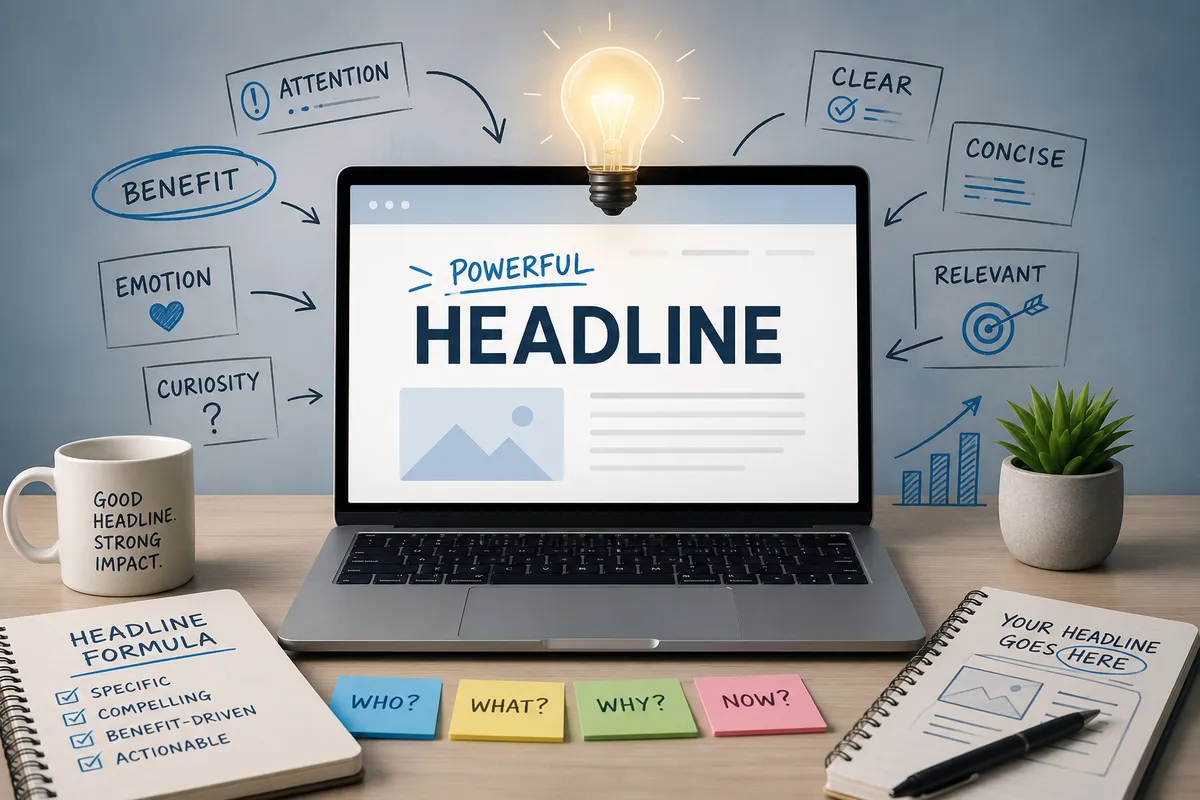
How To Write A Powerful Website Headline
Your headline is the first thing visitors read. Make it count.
Imagine walking into a shop where the owner simply says, "Welcome."
It's polite, but it doesn't tell you anything. You still don't know what the shop sells, whether it's relevant to you, or why you should stay.
The same happens on thousands of websites every day.
A visitor lands on a homepage and sees a headline like:
Welcome to Our Website
Or:
Innovative Solutions for Modern Businesses
Neither tells them what the business actually does.
A great website headline isn't clever—it communicates. It quickly answers the questions every visitor is asking:
What do you offer?
Who is it for?
Why should I care?
Get those answers across in a few seconds, and you've earned the visitor's attention. Miss the mark, and they'll likely leave before reading another word.
Why Your Website Headline Matters
Studies have shown that people form an opinion about a website within seconds.
Your headline is usually the first sentence they read. It sets expectations for everything that follows.
A strong headline helps visitors immediately understand they're in the right place.
A weak headline creates confusion.
And confused visitors rarely become customers.
What Makes a Great Website Headline?
The best headlines are surprisingly simple.
They don't rely on buzzwords or clever wordplay. Instead, they focus on clarity.
A powerful headline should:
Clearly explain what you do.
Speak directly to your ideal customer.
Highlight the main benefit.
Spark curiosity without being misleading.
Think of your headline as the answer to one question:
"Why should I stay on this website?"
Start With the Problem You Solve
People visit websites because they need something.
Maybe they're looking for a restaurant.
Maybe they need a lawyer.
Maybe they want to create a website.
Your headline should immediately connect with that need.
Instead of saying:
Welcome to Smith Consulting
Try:
Business Consulting That Helps Small Companies Grow Faster
Instead of:
John's Plumbing
Write:
Fast, Reliable Plumbing Services Available 24/7
Notice the difference?
The second examples focus on what the customer gets—not just the company name.
People don't buy products or services because they're interesting. They buy them because they solve problems.
Focus on Benefits, Not Features
Here's a common mistake.
A company writes:
AI Website Builder
That's a feature.
Now compare it with:
Create a Professional Website in Minutes - No Coding Required
That's a benefit.
Visitors care less about how you solve their problem and more about what they'll achieve.
Whenever you write a headline, ask yourself:
"What's the outcome my customer wants?"
Lead with that.
Keep It Simple
Many businesses try to sound impressive.
Unfortunately, that often makes their message harder to understand.
Avoid phrases like:
Innovative Digital Solutions
Empowering Business Growth
Next-Generation Technology
Industry-Leading Excellence
These phrases could describe almost any company.
Instead, use everyday language.
If you'd say it to a customer in person, it's probably a good headline.
Be Specific
Specific headlines build confidence.
Compare these examples.
Too vague
We Help Businesses Succeed
Better
Accounting Services for Freelancers and Small Businesses
Or:
Too vague
Build Better Websites
Better
Create an SEO-Ready Website in Under 10 Minutes
Specificity makes your message more believable.
The more clearly you describe your offer, the easier it is for the right audience to recognize that they've found what they're looking for.
Think About SEO -But Write for People First
A website headline isn't just the first thing your visitors read—it's also one of the first signals search engines use to understand your page.
That doesn't mean you should stuff your headline with keywords.
Instead, write the way your customers search.
For example, imagine you're a wedding photographer.
This headline sounds elegant:
Capturing Life's Most Beautiful Moments
But it doesn't tell visitors - or Google - what you actually do.
Now compare it with:
Wedding Photography for Modern Couples in Chicago
In just a few words, you've explained your service, your audience, and your location. It's clearer for people and easier for search engines to understand.
The same principle applies to every business.
If you're a personal trainer, don't hide behind a slogan. Tell people exactly what you offer.
If you're a restaurant, mention your cuisine or specialty.
If you're a lawyer, explain your area of expertise.
One of the easiest ways to improve your SEO is by using long-tail keywords naturally in your headline.
Long-tail keywords are longer, more specific search phrases that people use when they know exactly what they're looking for.
For example:
AI website builder for small businesses
Website design for restaurants
Affordable family lawyer in Austin
Wedding photographer in New York
Personal trainer for beginners
Someone searching for "website builder" could be looking for anything.
Someone searching for "AI website builder for small businesses" has a much clearer intention and is often closer to making a decision.
That's why long-tail keywords are valuable - they usually have lower competition and attract visitors who are more likely to become customers.
The important thing is to use them naturally.
If your headline sounds awkward because you're trying to fit every keyword into one sentence, rewrite it.
Your first goal is always clarity.
SEO Tip: Don't write headlines for search engines. Write them for your customers using the same language they use when searching online. Modern search engines are smart enough to understand context, so natural, helpful headlines almost always perform better than keyword-stuffed ones.
Don't Be Afraid to Mention Your Audience
Sometimes the easiest way to attract the right visitors is simply to name them.
Examples:
Websites for Restaurants
Marketing for Local Businesses
Accounting Services for Startups
Fitness Coaching for Busy Professionals
When people see themselves in your headline, they immediately feel like they're in the right place.
Pair Your Headline With a Supporting Sentence
A headline doesn't have to explain everything.
That's what the subheadline is for.
For example:
Headline
Create a Professional Website in Minutes
Supporting text
Use AI to generate a beautiful, SEO-friendly website - no coding, no design skills, and no complicated setup.
Together, they answer almost every question a visitor has.
Common Website Headline Mistakes
Making It About Your Company
Visitors care more about their own problems than your company history.
Instead of:
Family-Owned Since 1998
Try:
Trusted Home Renovation Experts Serving Chicago for Over 25 Years
The experience becomes a benefit.
Trying to Be Too Clever
Creative headlines can be memorable - but only if people understand them.
If visitors have to stop and think, you've already lost valuable attention.
Clear always beats clever.
Saying Too Much
Your headline isn't your sales pitch.
Keep it concise.
Aim for one clear message.
Using Generic Marketing Language
Words like:
Amazing
Revolutionary
Premium
Innovative
don't build trust on their own.
Show value instead of describing yourself with adjectives.
Website Headline Formulas That Work
You don't have to start from scratch.
These simple formulas work across almost every industry.
Formula 1
Get [Desired Result] Without [Big Pain Point]
Example:
Create a Professional Website Without Writing a Single Line of Code
Formula 2
Helping [Audience] Achieve [Goal]
Example:
Helping Small Businesses Build Their Online Presence
Formula 3
[Service] That Helps You [Benefit]
Example:
Accounting Services That Save You Time and Money
Formula 4
Fast, Simple, Reliable [Service]
Example:
Fast, Reliable Heating Repairs Across London
Formula 5
The Easier Way to [Goal]
Example:
The Easier Way to Launch Your Business Website
Test Different Headlines
Don't assume your first idea is your best one.
Professional copywriters rarely settle on the first headline they write.
Instead, create five or ten different versions.
Read them out loud.
Ask a colleague, friend, or even an existing customer which one makes the most sense.
Sometimes changing just a few words can significantly improve how people respond.
Can AI Help Write Better Headlines?
Absolutely.
AI is excellent at generating ideas when you're staring at a blank page.
It can suggest multiple headline variations, explore different tones, and help you refine your message.
The best results come when you combine AI's speed with your own understanding of your customers.
Think of AI as your brainstorming partner - not your replacement.
A website headline doesn't need to be clever, funny, or complicated.
It needs to be clear.
When visitors instantly understand what you offer, who it's for, and how it helps them, they're far more likely to stay on your website and take the next step.
A great headline also serves two audiences at once. It helps visitors quickly understand your business while giving search engines valuable context about your page. When you combine clear messaging with naturally written keywords, you create a homepage that's easier to find - and more likely to convert.
Before you publish your homepage, ask yourself one simple question:
If someone read only my headline, would they understand what my business does?
If the answer is yes, you're on the right track.
If you're building your website with Instago.ai, you can generate professional homepage headlines in seconds and customize them to match your business, industry, and brand voice. It's a faster way to move past the blank page and create a homepage that makes a great first impression.
Frequently Asked Questions
How long should a website headline be?
Aim for 6–12 words. It should be long enough to explain your value but short enough to read at a glance.
Should I include keywords in my headline?
Yes - but naturally. Focus on writing for people first, then incorporate relevant keywords where they fit naturally. Long-tail keywords can be particularly effective because they attract visitors with a clear intent.
Can a funny or creative headline improve conversions?
It depends on your audience. Creativity can work, but clarity should always come first. If visitors don't immediately understand what you offer, a clever headline may do more harm than good.
How often should I update my website headline?
Review it whenever your business evolves, you launch new services, or your messaging changes. It's also worth testing different headlines over time to see which one resonates most with your audience.